Tag: taste

  • What is the Aeropress brewing method

    What is the Aeropress brewing method

    [fusion_builder_container hundred_percent=”no” equal_height_columns=”no” menu_anchor=”” hide_on_mobile=”small-visibility,medium-visibility,large-visibility” class=”” id=”” background_color=”” background_image=”” background_position=”center center” background_repeat=”no-repeat” fade=”no” background_parallax=”none” parallax_speed=”0.3″ video_mp4=”” video_webm=”” video_ogv=”” video_url=”” video_aspect_ratio=”16:9″ video_loop=”yes” video_mute=”yes” overlay_color=”” video_preview_image=”” border_color=”” border_style=”solid” padding_top=”” padding_bottom=”” padding_left=”” padding_right=”” type=”legacy”][fusion_builder_row][fusion_builder_column type=”1_1″ layout=”1_1″ background_position=”left top” background_color=”” border_color=”” border_style=”solid” border_position=”all” spacing=”yes” background_image=”” background_repeat=”no-repeat” padding_top=”” padding_right=”” padding_bottom=”” padding_left=”” margin_top=”0px” margin_bottom=”0px” class=”” id=”” animation_type=”” animation_speed=”0.3″ animation_direction=”left” hide_on_mobile=”small-visibility,medium-visibility,large-visibility” center_content=”no” last=”true” min_height=”” hover_type=”none” link=”” border_sizes_top=”” border_sizes_bottom=”” border_sizes_left=”” border_sizes_right=”” first=”true” type=”1_1″][fusion_text columns=”” column_min_width=”” column_spacing=”” rule_style=”default” rule_size=”” rule_color=”” content_alignment_medium=”” content_alignment_small=”” content_alignment=”” hide_on_mobile=”small-visibility,medium-visibility,large-visibility” sticky_display=”normal,sticky” class=”” id=”” font_size=”” line_height=”” letter_spacing=”” text_color=”” animation_type=”” animation_direction=”left” animation_speed=”0.3″ animation_offset=””]aeropress brew method

    What is the Aeropress brewing method

    Are you a coffee lover looking for a new brewing method? Look no further than the Aeropress! This innovative device has quickly become popular in the coffee world. An Aeropress is easy to use, versatile and will produce a delicious cup of coffee.

    The Aeropress was invented by Alan Adler, a Stanford University engineering instructor, in 2005. Its construction consists of two main parts: a plunger and a chamber. To brew coffee with an Aeropress, simply place a filter in the cap, add ground coffee to the chamber, and pour in hot water. After stirring the mixture, insert the plunger and press down to extract the coffee.

    It’s worth noting that the ideal grind for an Aeropress is a medium-fine grind to allow for a balanced extraction. However, this brew method allows for a variety of grind types, so don’t be afraid to experiment. 

    What sets the Aeropress apart from other brewing methods is its versatility. The device allows for several brewing techniques, from a quick and simple brew to a more complex and nuanced cup, depending on the coffee’s origin and roast profile. In addition to its versatility, the apparatus is portable and easy to clean, making it an excellent option for coffee lovers always on the go. Its compact size makes it easily fit into a backpack or suitcase.  An Aeropress is the perfect travel companion for coffee lovers.

    The Aeropress is also a popular choice for coffee cupping competitions thanks to how it produces a clean and nuanced cup of coffee. Its versatility enables a wide range of brewing techniques, which can highlight the unique flavors and aromas of different coffee varieties.

    To get started with the Aeropress, begin by experimenting with different brewing methods. Some popular techniques include the standard method, the inverted method, and the immersion method. Each technique produces a unique flavor profile, so don’t be afraid to try them all and find your favorite.

    In addition to its versatility, the Aeropress can be trusted to produce a clean and smooth cup of coffee. The device uses pressure to extract the coffee, which results in less acidity and bitterness compared to other brewing methods. This makes it a great option for those with sensitive stomachs, gastrointestinal sensitivities and those who prefer a milder cup of coffee.

    Overall, the Aeropress is a very affordable and excellent brewing method for coffee lovers. Its ease of use, versatility, and ability to produce a delicious cup of coffee make it a must-have for any coffee enthusiast. So why not try it and see what all the hype is about?

     [/fusion_text][/fusion_builder_column][/fusion_builder_row][/fusion_builder_container]

  • Coffee Donated to Rescue Crews at Surfside Condo Collapse

    Coffee Donated to Rescue Crews at Surfside Condo Collapse

    [fusion_builder_container hundred_percent=”no” equal_height_columns=”no” menu_anchor=”” hide_on_mobile=”small-visibility,medium-visibility,large-visibility” class=”” id=”” background_color=”” background_image=”” background_position=”center center” background_repeat=”no-repeat” fade=”no” background_parallax=”none” parallax_speed=”0.3″ video_mp4=”” video_webm=”” video_ogv=”” video_url=”” video_aspect_ratio=”16:9″ video_loop=”yes” video_mute=”yes” overlay_color=”” video_preview_image=”” border_color=”” border_style=”solid” padding_top=”” padding_bottom=”” padding_left=”” padding_right=”” type=”legacy”][fusion_builder_row][fusion_builder_column type=”1_1″ layout=”1_1″ background_position=”left top” background_color=”” border_color=”” border_style=”solid” border_position=”all” spacing=”yes” background_image=”” background_repeat=”no-repeat” padding_top=”” padding_right=”” padding_bottom=”” padding_left=”” margin_top=”0px” margin_bottom=”0px” class=”” id=”” animation_type=”” animation_speed=”0.3″ animation_direction=”left” hide_on_mobile=”small-visibility,medium-visibility,large-visibility” center_content=”no” last=”true” min_height=”” hover_type=”none” link=”” border_sizes_top=”” border_sizes_bottom=”” border_sizes_left=”” border_sizes_right=”” type=”1_1″ first=”true”][fusion_text columns=”” column_min_width=”” column_spacing=”” rule_style=”default” rule_size=”” rule_color=”” content_alignment_medium=”” content_alignment_small=”” content_alignment=”” hide_on_mobile=”small-visibility,medium-visibility,large-visibility” sticky_display=”normal,sticky” class=”” id=”” font_size=”” line_height=”” letter_spacing=”” text_color=”” animation_type=”” animation_direction=”left” animation_speed=”0.3″ animation_offset=””]BELFOR vehicle with 45 pounds of fresh roasted coffee from Grumpy Goat Coffee roastery along with brewing equipment and coffee supplies donated by Stan’s Coffee, BELFOR and M&M Multimedia.

    Grumpy Goat Coffee Donated to Rescue Crews at Surfside Condo Collapse

    The BELFOR Property Restoration office in Bonita Springs, Fla., Grumpy Goat Coffee Company, Stan’s Coffee & Food Service and Fort Myers based marketing agency M&M Multimedia have collaborated with the BELFOR branch in Deerfield Beach, Fla. to donate more than 2,000 cups of coffee, commercial coffee brewing equipment and related coffee supplies to Mercy Chefs and the rescue crews working at the scene of the Champlain Towers South condo building in Surfside, Fla.

    Mercy Chefs, a faith-based, non-profit disaster relief organization is in Surfside to provide professionally prepared, restaurant-quality meals to victims, volunteers, and first responders responding to the tragic building collapse. Shift after shift, they dutifully continue their unimaginable efforts, resting for just a few hours in between. When their shifts are over, Mercy Chefs is there to offer them a hot meal and a listening ear before they sleep and then head back again.


     [/fusion_text][/fusion_builder_column][/fusion_builder_row][/fusion_builder_container]

  • Espresso’s Dark Hidden Secret

    Espresso’s Dark Hidden Secret

    Espresso’s Dark Hidden Secret

    We get the question from customers all the time. Do you have espresso beans?

    Most people expect to hear a yes or no answer.

    But it’s not that simple.

    We gently coach people that espresso is not a type of bean or a specific roast type.

    Espresso coffee
    Courtesy: Demion, CC BY 2.0, via Wikimedia Commons

    It’s a type of grind and brew method.

    You will see it as a setting on many coffee grinders and it results in a finer grind.

    Any coffee beans can be ground to an espresso level of fineness. That doesn’t mean that every coffee bean makes a great cup of espresso.

    Which brings us back to the premise that Grumpy Goat loves to teach coffee lovers about.

    A main key to the perfect cup of coffee is the quality and freshness of the coffee beans.

    Espresso is widely popular. The power of marketing and messaging has taught us that it is a special coffee experience. Espresso lovers have come to cherish the crema that forms on the surface of their espresso style coffee.


    What exactly is espresso?

    There’s more to the espresso story than meets the eye.

    In fact, there’s a dark hidden secret about traditional espresso.

    It has to do with the coffee beans used to make it.

    Typically, espresso is a blend of arabica coffee beans with some robusta coffee beans.

    Robusta beans, although low quality and almost undrinkable on their own, serve two important roles in the making of an espresso.

    First, the robusta beans contain about double the caffeine of arabica beans.
    Second, it’s the robusta bean that allows for a thicker crema to form on top.

    What really defines an espresso is how it is brewed, and that’s why the grind type is critical.

    The grind size for espresso is very fine. This fineness creates a more compact surface area and resistance for the pressurized hot water to flow through. This process results in a more intense and concentrated coffee experience.

    An espresso machine is designed to create pressurized extraction as it forces hot water under very high pressure through a compressed bed of roasted, ground coffee.

    This style of coffee is widely popular, helped along with mass marketing that this is how a great cup of coffee should be experienced and thereby creating a use for robusta coffee beans that are bitter on their own.


    The secret behind espresso crema

    Espresso style coffee is known for the thick foamy crema that forms on the surface of the coffee.

    Reddish and caramel in color, the tiny bubbles of the crema are visually appealing and make for great Instagram posts.

    But the carbon dioxide gas in the crema contributes to the bitterness of the espresso taste.

    So, it’s not uncommon to have an attractive looking espresso with a less than desired taste.

    See for yourself and try scraping the foam away and letting the coffee stand on its own. Or, mix the crema in and experience an entirely different flavor profile.

    Either way, know that you can enjoy a strong cup of espresso without an overly thick crema as long as you are using fresh, high quality coffee beans.


    Does Grumpy Goat have espresso beans?

    goat on coffee farmIt’s a valid question and we are happy to answer and offer advice.

    But it all starts with the origin, quality and freshness of the beans.

    Grumpy Goat focuses solely on high quality, single origin, fully traceable coffee beans. No blending, no flavoring, no risk of mishandling.

    There are several Grumpy Goat coffee origins that will make a great espresso style experience.

    Examples include Colombian, Ethiopian, Kenyan and Sumatra and although traditionally most people would opt for a dark roast, do not be afraid to try making an espresso with a medium roast.

    In fact, many coffee-forward cultures such as in Scandinavia, have fully embraced enjoying espresso style coffee using single origin beans and using lighter roast profiles than the traditional Italian espresso.

    There’s no right or wrong here. It boils down to your personal taste and we encourage you to experiment and land on what types of coffee fit best with your palate.

    But without the blending of the robusta beans you are unlikely to see the same thick, foamy lid form on the surface of your cup. Not to say there won’t be some crema – there will be – just not the same as when the low quality robusta beans are blended in.

    The crema is arguably a mask that inhibits the true tasting notes of the beans from being experienced. If you’re using low quality beans then perhaps the crema is a nice complement to hedge against the bitterness.

    But when you’re using high quality coffee beans you want that flavor profile to shine.

    And remember, it’s the marketing that has “taught” us that the crema is what makes espresso special.

    We think it’s still all about the coffee.


  • How to do Coffee Cupping at Home

    How to do Coffee Cupping at Home

    How to do Coffee Cupping at Home

    One skyrocketing trend that was triggered by people spending more time indoors during the coronavirus pandemic is brewing coffee at home. “Coffee Cupping” is the process of tasting, describing, and scoring coffee.

    Trying different coffees and different brewing methods can be fun – a lot like doing a wine tasting.

    Expertly trained and licensed professional “cuppers” grade the coffees. These very skilled individuals have completed testing requirements much like the Master Sommeliers in the world of wine.

    So we thought we would share some tips about how to do a coffee cupping at home.


    cupping coffee at home

    Items Needed for Coffee Cupping

    No fancy equipment required!

    Preparing to have fun with your at-home coffee cupping only requires a few simple items which you’ll find already in most kitchens.

    Even if you do not have exactly the right items, you can improvise without too much inconvenience.

    Here’s your short list of items to gather:

    • Fresh roasted coffee beans (we recommend 3 or 4 single origin coffees)
    • Coffee grinder (use a medium grind setting)
    • Kitchen scale with grams setting
    • Bullion (soup) spoons
    • Tea kettle
    • Cupping vessels
    • Pen and paper for taking notes

    If you do not have a coffee grinder at home, no problem. Just make sure that you use freshly ground coffee from your favorite roaster. 

    Or, if you are curious about getting your own coffee grinder, check out our coffee grinding article for options and tips.

    What heck is a “cupping vessel?” A vessel is ceramic or tempered glass that holds 7-9 fluid ounces and is around three inches in diameter like in this picture courtesy of Olam Coffee.


    Preparing for your Coffee Cupping

    coffee cupping vesselsA good coffee cupping experience will include at least three or four single origin coffees. But if you are feeling more adventurous you can certainly expand that number.  Generally, you can cup six samples with a single tea kettle.

    Grumpy Goat offers at least twelve single origin coffee options throughout the year and usually more as we receive other origins in limited quantity depending upon the season.  Here are a couple of different strategies or themes you can consider for your coffee cupping experience:

    1. Region Specific Comparison

    There are four main regions in the World where the best coffee is grown: Africa, Indonesia, South America, Central America. One cupping theme you can try is the select all your single origin coffees from the same region and compare them. For example if you do an African theme you can cup with Kenyan, Ethiopian, Tanzanian and Burundi and compare and contrast them. Even though they are all from African you will find them to all be unique.

    2. Cross-Region Comparison

    Alternatively, you can prepare a coffee cupping experience where you compare different parts of the World. For example, you can get one single origin from each of the four main growing regions. One grouping that would offer a diverse menu would include Ethiopian, Costa Rican, Peruvian and Sumatra.

    Put 8-10 grams (approximately 0.3 ounces) of ground coffee into each cup or bowl.

    Start your tea kettle to boil the water. (Reminder – water affects coffee taste so check out our tips about water for brewing coffee)


    Coffee Grind Aroma – Dry

    coffee cupping sniffing vessels of coffeeThe first part of your coffee cupping evaluation is the sniff the aroma of the dry coffee grinds.

    Jot down your notes about what you smell. You may not be able to pinpoint the exact words about what you smell but don’t worry – write something – there’s no wrong answers.

    Many people struggle to assign names to smells.

    In fact, the words you may choose can be similar to the tasting notes of a coffee.

    Here is a short cheat list of vocabulary that you may experience while sniffing the coffee grind aroma: floral, nutty, cocoa, vanilla, fruity, musty, cinnamon, caramel, fragrant, spicy, citrusy.

    This isn’t a complete list by any means but will put you on the right path. Don’t be afraid to use your own words. There is no wrong answer.

    And keep in mind that each person has their own sensitivities to smells and tastes. So even if your coffee cupping pals experience a different aroma than you, it does not mean that someone is wrong.

    Repeat this for each coffee you have.

    If your nose becomes overwhelmed by too many scents, you can hit the reset button on your nose by sniffing your forearm.


    Coffee Grind Aroma – Wet

    The tea kettle is whistling and you’re ready to pour some hot boiling water on the dry coffee grinds.

    But before we taste it is important to experience the aroma of the coffee after the grinds are soaked with some boiling water.

    1. Pour 150 ml of water (about 5 fluid ounces) “just off the boil,” (around 200°F / 93°C) over the grounds in each cup.
    2. Wait about four minutes. Watch for a crust of coffee grounds that forms on top of each cup.
    3. Using the back of your soup spoon, push the grounds aside while sniffing the coffee. TIP: position your nose close-in as you “break the crust”; this is the moment when most of the coffee aromas are released.
    4. Make sure all of the grounds have been broken up completely.
    5. Just like you did with the dry coffee grounds, jot down what you smell. Remember, there’s no wrong answers.
    6. Remember to rinse your spoon between each coffee to avoid mixing them together.

    HINT: have a glass of the rest of the water from the tea kettle on the table so you dunk your spoon to rinse.


    Removal of Grinds when Coffee Cupping

    Before we move on to tasting the coffee, there’s one step required which may take some repetition before you get the technique down but don’t stress over it.

    Coffee cupping at home is supposed to be fun so don’t get caught up in the technique.

    When you “break the crust,” the coffee grounds will settle to the cup’s bottom.

    You should see a caramel-colored foam still floating on the surface.

    Professional coffee cuppers use two spoons, held vertically, to steer that foam into one spot of the cup and then pull it all out at once. Years of practice and cupping hundreds of vessels help them perfect this technique.

    But at home you do not need to be perfect. Do your best at cleaning the surface of the coffee of any remaining foam.

    Don’t forget to rinse your spoon between coffees.


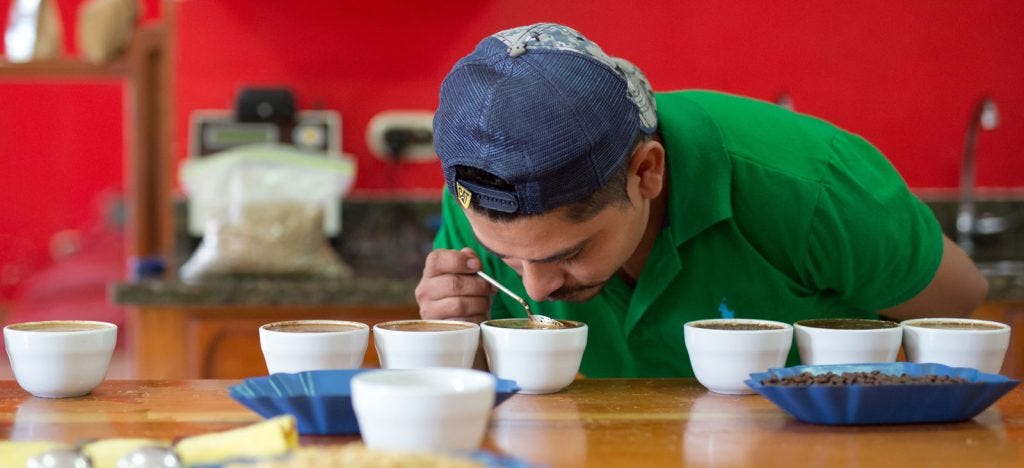
    coffee cupping at home and slurping the coffeeIt’s Time to Taste the Coffee

    We do not want anyone burning their tongue and taste buds so allow the coffee to cool from boiling. 

    Tasting Round 1 of Coffee Cupping

    Lift a spoonful of coffee to your lips and “slurp it into your mouth like a rude dinner guest eating soup.” (we borrowed that well put phrase from Olam Coffee)

    The action of slurping is helping you cool down the hot coffee but also you are intaking air which will send some of the coffee compounds back up into the smell receptors behind your nose.

    Another Reminder: rinse your spoon after each cup so you are not co-mingling tastes

    Then, just like with your smell tests, jot something down.

    Here is a short cheat list of vocabulary that you may experience while sipping the coffee: nutty, chocolaty, bright, earthy, rich, sweet, savory, vanilla, berries, fruity, cinnamon, caramel, spicy, citrusy, bitter, dull, dry, smooth, tea-like, full body.

    Taste is subjective so there are no wrong answers here. 


    Tasting Round 2 of Coffee Cupping

    After completing the first round of sipping and note taking, let the coffees cool for another five minutes.

    Then taste all of them again following same process.

    The tasting notes of coffee will change as it cools.

    On your second round you will experience new things about the coffee as the temperature changes.

    Jot down those additional notes.

    Coffee Cupping at Home with Friends

    After completing the note taking on all the coffees, all the participants can share their findings, rank their favorites and compare notes.

    Similar to participating in a wine tasting, the use of flavor profiles and tasting notes and aromas to describe coffee is the at the core of a fun coffee cupping experience at home.

    Just like it matters to properly prepare and serve wine, it is important to properly prepare and serve coffee to experience the best cup possible.

    Now that you have the process down for doing a coffee cupping event at home you can invite your friends to a unique and fun experience.